Update 4: Wild is the Wind
over 4 years ago
– Fri, Mar 18, 2022 at 02:27:16 AM
Two weeks in, two to go, and we're breezing along at a solid 70%. If we can keep pace we should blow past our goal before all is said and done. Thanks as always for your support so far as well as every signal boost. It helps a lot.
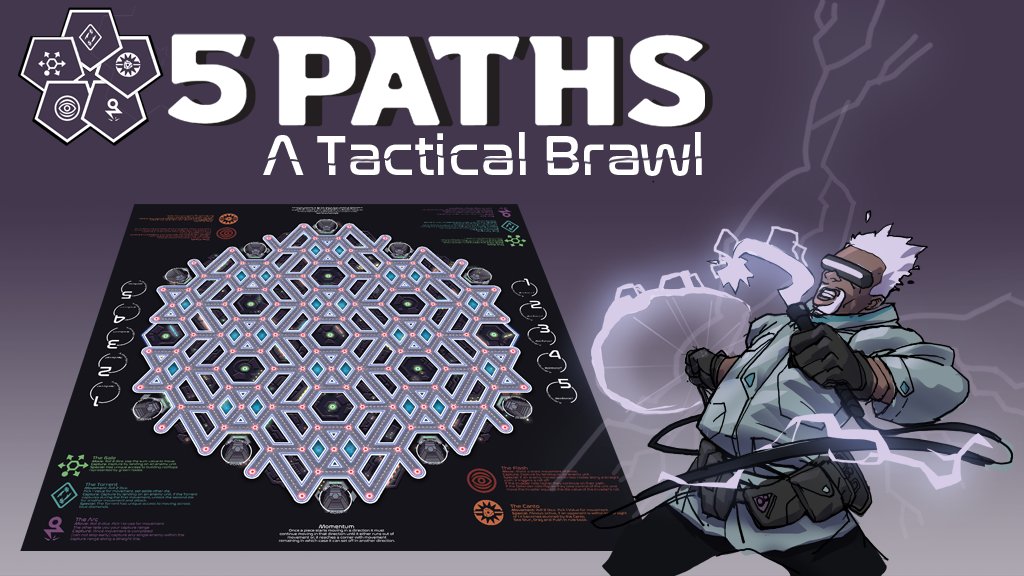
Continuing the dev diary, let's talk about the first and simplest piece: The Gale.
When this started I had an impulse, and it was a very strong impulse, to throw as much as I could into a single game design. I wanted a game that was portable with high replay value. I wanted highly individuated pieces with multiple situational abilities and effects. I wanted a quick game that went down like a hearty meal. I might have had to compromise on some of those goals. One reason (the main reason), I didn't really know what I was doing. For another thing , a game is useless if you can't get anyone to play it.
In game design (and arguably most endeavors that engage with an audience) you have to be mindful of what you barriers to entry are. Presuming that the game is able to sustain engagement once people are invested (more on this later), we have to be mindful of what might put people off before they are invested. There are a number of things that affect this: aesthetics, complexity of rules, opacity of rule explanation (not the same thing as complexity, designing something and making it make sense to people are two entirely different skill sets,) the number of things players are expected to keep track of, and perceived shallowness are some, but not all, of the things that can put someone off of a game.
What's more, if you do this right, the reason that one person loves your game will be the same reason that someone else hates it.
This is a good thing.
It can help rein in your focus from being something that everyone has to like to being something coherent and cohesive. Coherent meaning reasonably easy for someone to understand when you aren't there to teach them directly and cohesive meaning that, whether your game is symmetric or asymmetric, all decisions revolve around the same core. Without cohesion you game ceases to be a singular game and instead becomes a loose confederation of smaller games sharing a coat, which is fine if that's your goal but sloppy if it's an incidental development.
One of the best pieces of advice I've received since starting on this was to "begin with the pawn." Figure out how the most basic piece works before adding variation and this brings us to the genesis of the Gale.
The first ever game of 5 Paths was played on March 20, 2015, at around 1 am. I didn't have suitable pieces for the prototype so I used 4-sided dice to stand in for what would ultimately become the Gale and rolled 2d6 for movement.
Two things were immediately clear:
1.) without a rule like Momentum, every turn would take forever.
2.) The core gameplay capture loop was solid.
In the most straightforward piece we find the simplest goal in a core game piece: move and get the thing. Even in its finished state, the gameplay loop can be simplified to:
- Pick your fighter
- Take your chances
- Go after the thing
Nowhere is that simpler than it is with the Gale where you roll two dice and take the sum for movement. It's thematized as a speedster but it plays like a sniper, shooting clear across board to its target.
The Gale is the piece that has changed the least since its inception because, frankly, it hasn't had to. Its simplicity and efficacy cements the core of the game. The core engine is the dice. Every piece uses the dice in their own specialized way. Die roll probabilities mean different things when refracted through different piece mechanics. We'll dig into this a little more in the next installment.
- Nick
Update 3: On Boarding
over 4 years ago
– Tue, Mar 15, 2022 at 11:54:20 PM
Just under 3 weeks to go and we are 2/3s of the way to victory. Thanks as always for your support. It means a lot. Continuing the dev thread from Update 2: Let’s talk about how the board got its shape.
While I can't deny the influence of Chess on 5 Paths, one thing I knew well before I realized that this thought experiment would carry forward to a fully realized game, was that I didn't want to make a simple Chess clone.
To clarify: I typically tell people that 5 Paths is equal parts Chess, Chinese Checkers, and Backgammon. There's no shortage of Chess variants and while I knew that I wouldn't be able to fully escape that shadow, I had to hope that my variation wouldn't come across as formulaic. So I made three important decisions.
- I would add dice or another randomizing element to the game.
- I would not use the standard chess/checker board.
- My piece archetypes would not be reliant on a distinct hierarchical value.
Changing the board seemed like one of the most significant distinctions, but I had no idea how to go about it. As much as I would like to pretend that I had a clear vision for this from the outset, the truth is that it's been a series of hitting road blocks and finding my way around them. The game was a vague, but persistent thing. So I did what I always do when I can't wrap my head around something. I sought out my Sometimes Antagonistic Mentor.
I'll call him Sam for short, and I would be remiss if I didn't also mention that I can be a pretty stubborn student. Sam's the person that got me into game design by asking me to help with one of his projects. He clued me into the difference between space-to-space (Checker board) and node-to-node (Risk) movement and from there we examined a number of different geometric sequences that could serve as the skeleton for my thought experiment. I found one I liked, with hexagons and lines that doubled in on each other. I imagined something akin to a more tactical version of Chutes and Ladders that also invoked the vertigo of the climactic scene in Darkman.
I am not a trained artist.
My attempt to recreate and expand this pattern were largely unusable. The idea, I think, was to use a mechanic where pieces completed an action and were forced to slide to a different level of the board but
I couldn't get the map to work, so I went to Sam again. He talked to me about the relationship between complexity and depth in games which was not what I wanted to hear about. I wanted to know how to get the ball rolling. Of course, Sam was right, and a better understanding of the relationship between complexity and depth would ultimately help with the board issue, but my immediate concern was finding a way to articulate what was developing in my head and give it a tangible form. I opted to go back to basics.
There used to be an Ambassador Toy store in the Embarcadero Center in San Francisco and a very kind woman named Beth worked there. She was patient enough to hear me ramble about what I was attempting and wise enough to direct me to a toddler's geometrical magnetic toy. This toy would be instrumental in the hex based board I would ultimately use. Each hex could support different combinations of diamonds and triangles. The junctures where the magnets connected allowed for simple nodes and lines. What I saw wasn't what I initially hoped for, but it was substantially easier to implement and teach. After 6 hours with a ruler, a pencil and some butcher paper, I had a rudimentary map. The next step would be to figure out what to do about the pieces.
Update 2: Life ain't Chess
over 4 years ago
– Wed, Mar 09, 2022 at 03:25:13 PM
Hello all,
We are officially a week in and 60% of the way. It's all kind of surreal. Thank you for your support so far. This has been a long labor of love and it's super gratifying to see how much you guys have showed up for us.
I can remember where I was and roughly when I got the idea for 5 Paths, but if time spent in history class has taught me anything, “when” and “where” mean little without an understanding of why. So when and where are freebies. The first spark of inspiration hit me when I was closing down a small cafe in Embarcadero Center in San Francisco in the winter of 2014. It began with a simple question: how would one account for the lack of agency felt by an inexperienced Chess player who’s facing a more experienced opponent?
If you ask five game designers what game design is chiefly about, you’ll probably get three different answers. If you ask me, I’ll likely change my mind depending on the day. One thing I tend to believe more often than otherwise is that game design, at its core, is about creating an experience. It follows that different types of experiences will appeal to different types of players. Forgive me for stating the obvious. There’s a point.
Chess is a game with a long standing pedigree and a longer history. Despite my gripes with the stalemate rule (I’m still not a very good chess player) I wouldn’t presume to say that I bring any greater authority to bear on a subject that has been studied and commented on for such a long time. With that understood, if a 50 turn game is a foregone conclusion on turn 10 and you still have to deliberate over and play out the remaining 40 turns, I have to wonder what the point is of continuing the game. More specifically, if a novice sits down to play and is told that the end game is miles away but it doesn’t matter because they’ve already lost, that dynamic presents a massive barrier to engagement. If a well designed game prioritizes the experience it creates, then these barriers work against the designer’s objective. I’m not saying that there are games out there without any barriers to entry, but a designer has to be mindful of them. So we go back to that café in Embarcadero, and the barista with a broom in hand.
5 Paths, and my earnest journey as a game designer began on accident, with a question: How do I create a flexible, competitive game which rewards skill and strategy without being inaccessible to new players?
Eight years later, I have 5 Paths in a publishable state. It takes a game or two on average for new players to understand the basics and start forming their own preferences and strategies. Tune in next time and I’ll explain how the board came to take the shape that it did.
-Nick
Update 1: Saturday Night's Alright!
over 4 years ago
– Sat, Mar 05, 2022 at 07:20:23 PM
Hello all,
We're just about a week into the campaign and already over half way to our goal! Thank you all for your support so far and if you know anyone who seems like they'd dig the game please let them know about it. Every bit helps.
On another note, we are aware that there were a few hiccups day one with pledge delays and/or restrictions for backing in certain countries. If you or anyone you know had trouble getting in please let us know ASAP and we will try to resolve the issue.
For anyone interested in trying the game out ahead of time: we have a digital build out available here through Tabletop Simulator as well as a Discord Channel where you can connect with us as well as other 5 Paths fans (check that out here.)
All the best,
Nick